The Importance of Calculating Proper Load Capacity at Loading Docks
When specifying or replacing a dock leveler, selecting the right capacity may seem straightforward. However, choosing a leveler based solely on a weight rating can lead to an incorrect capacity selection. The actual demands placed on a dock leveler depend on the equipment being used, the load being carried, and how often the leveler will be operated.
Understanding these factors is essential for selecting the appropriate capacity and ensuring the dock leveler can safely and reliably handle the demands of the application.
Here’s why accurate load calculations matter, what can happen when capacity is incorrectly calculated, and how to properly select the right loading dock leveler for the application.
What Happens When You Miscalculate Load Capacity?
To understand why accurate load calculations matter, consider this real-life story from one of our Blue Giant experts about a warehouse in California.
The warehouse in California implemented a light-duty mechanical dock leveler with a data plate reading "30,000 lbs". Just one week after installation, the customer called Blue Giant support in a panic.
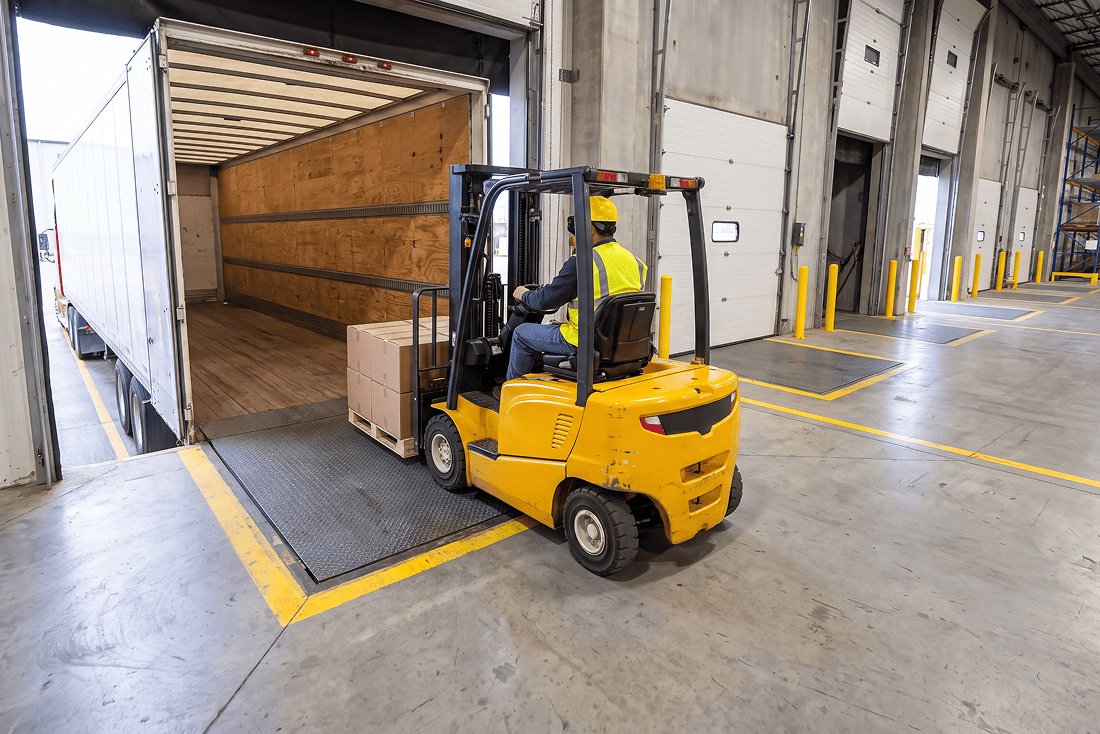
The dock leveler lip was folded straight up toward the sky, and pieces of broken metal were scattered across the floor. What went wrong? The warehouse was using a heavy forklift with a specialized clamp attachment to move massive 30,000-pound paper rolls across the dock. While the customer accounted for the weight of the product being handled, they did not include the weight of the forklift and its attachment when calculating the total load. As a result, the dock leveler was selected with insufficient capacity for the actual application.
In reality, the root of the problem was even deeper. That "30,000 lb" data plate was showing a Comparative Industry Rating (CIR), which only measured static parked weight. The actual live load capacity of that unit was only 12,500 pounds.
Driving 30,000 pounds, plus the weight of the forklift and attachment, over a leveler built for 12,500 pounds completely destroyed the equipment in seven days. To handle that heavy application, the facility actually needed a high-capacity hydraulic leveler rated for over 60,000 lb CIR.
The Light Bulb Comparison: Why Old Ratings Are Misleading
Why do so many people misunderstand loading dock ratings? Think about buying a light bulb.
For decades, everyone bought 40-watt, 60-watt, or 100-watt light bulbs based on how bright they wanted a room to be. But watts actually measure electrical power consumption, not brightness.
Today, modern LED light bulbs deliver 800 lumens of brightness while using only 9 watts of power. If someone offered you a "9-watt bulb" to replace your old 60-watt bulb, you might worry it would be too dark. In truth, the 9-watt LED is just as bright, because lumens measure true light output.
Dock leveler ratings work the exact same way. Old CIR ratings are like light bulb watts — they are somewhat misleading numbers that do not tell you real-world capacity. Live load ratings are like lumens — they tell you the true weight a leveler can support while moving across it every day.
A More Transparent Approach to Load Capacity
Blue Giant is helping simplify dock leveler selection by using transparent Live Load ratings and application-based capacity recommendations.
By publishing true live load ratings alongside daily truck traffic limits, these updated standards remove the guesswork from dock design. This reduces the need to interpret complex rating conversions, apply formulas, or decipher data plates. It helps ensure you recommend equipment designed specifically to handle real-world dynamic weight requirements.
Key Factors in Calculating Load Capacity
A dock leveler works just like a highway bridge. It does not just hold still weight; it absorbs repeated impacts from heavy traffic driving across it constantly. When calculating proper load application, you must evaluate three key considerations:
- Total Gross Weight: Add together the weight of the heaviest forklift, any attachments (like paper clamps), and the maximum payload weight carried.
- Daily Traffic Volume (Cycles): Count how many trucks enter the dock each day. Whether the dock handles 8, 16, or 24+ trucks daily is an important factor in determining the appropriate leveler capacity and expected duty cycle. Higher traffic and more frequent equipment crossings increase operational demands and can accelerate wear over time.
- Future Business Growth: Never calculate capacity based only on today's baseline. If the business grows and adds a second shift in two years, then the daily truck cycles will double. Whenever possible, calculate load capacity for expected workload 5 to 10 years into the future.
Protect Equipment and Personnel
Calculating proper load capacity prevents sudden equipment failure, avoids costly building repairs, and helps improve safety for employees at the dock.
Stop guessing with old static ratings. Registered Dealers and architects can log in to the Blue Giant portal to access our Load Capacity Calculator. This tool does the heavy math for you quickly and easily, so you can choose the right dock leveler with complete confidence.